

If your dentist has recommended a post and core treatment after a root canal, you may wonder why it is necessary. When a tooth has lost a significant amount of its structure due to decay, trauma, or previous dental work, a post and core restoration provides the support needed before placing a dental crown. This article explains the procedure, benefits, and when it is recommended.
Who Is This Article For?
This article is for patients who have recently undergone root canal treatment, those advised to get a dental crown, individuals with severely damaged teeth, or anyone looking to understand why a post and core restoration may be recommended before crown placement.
What is post and core treatment?
Post and core is a restorative procedure done after root canal treatment when a tooth has lost significant structure. The post is placed inside the prepared root canal space, and the core is built around it to recreate the missing tooth structure. This provides a foundation over which a dental crown can be placed.
Why is post and core needed after root canal?
After root canal treatment, some teeth may have very little natural structure remaining because of decay, fracture, or previous fillings. A crown needs enough tooth height and shape for retention. If the remaining tooth is too weak or short, post and core helps build the tooth so the crown can fit more securely.
Is post and core required after every root canal?
No. Many root-canal-treated teeth do not need a post if enough natural tooth structure remains. Molars, for example, may sometimes retain the core through the pulp chamber. A post is usually considered when there is major loss of coronal tooth structure and additional retention is needed for the core.
Does a dental post strengthen the tooth?
A common misunderstanding is that the post strengthens the tooth. In reality, the post mainly helps retain the core and crown. The long-term strength depends on remaining tooth structure, ferrule, crown design, bite forces, root length, and material selection. Over-preparing the root for a post can weaken the tooth, so the dentist must plan it carefully.
Types of posts used in dentistry
Posts may be prefabricated or custom-made. They may be made of fibre, metal, or other dental materials. Fibre posts are often used because they are tooth-coloured and have more favourable flexibility in selected cases. Metal posts may be considered in some situations depending on strength, space, bite, and remaining tooth structure.
What happens during post and core treatment?
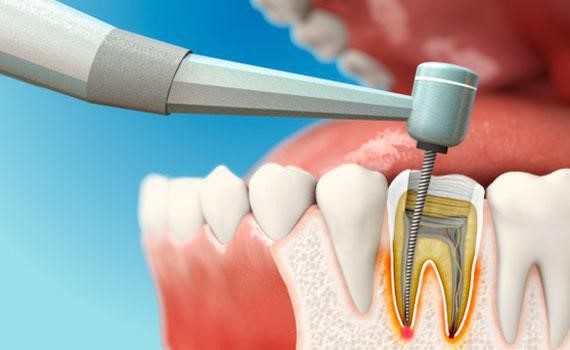
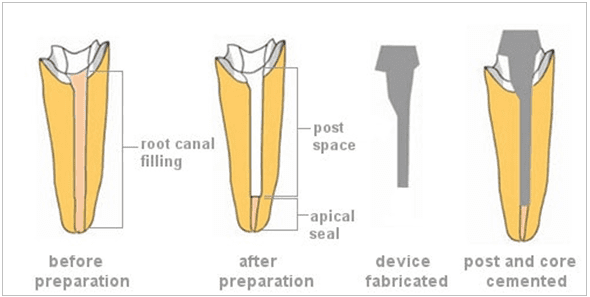
The dentist first confirms that the root canal treatment is complete and satisfactory. A small portion of root canal filling material may be removed from the canal space while keeping adequate seal at the root end. The post space is prepared, the post is tried and cemented, and core material is built up to recreate the tooth shape. The final crown is then planned over this foundation.
When post and core may not be suitable
Post and core may not be suitable if the tooth has a vertical root fracture, very short root, poor bone support, severe mobility, deep fracture below the gum, recurrent infection, or poor crown-to-root ratio. In such cases, extraction and replacement options may be discussed.
Post and core vs crown lengthening
Some badly broken teeth need both post and core and crown lengthening. Post and core builds the missing tooth structure, while crown lengthening exposes more healthy tooth above the gumline. The dentist decides based on fracture level, gum level, root support, and final crown margin.
How to care for a post and core tooth?
A tooth with post and core should be protected with a well-fitting crown where advised. Avoid biting hard objects, maintain oral hygiene, attend follow-up visits, and report pain, looseness, swelling, or crown movement early. Good crown fit and bite adjustment are important for long-term success.
Treatment procedure for root canal
After the Endodontics procedure, some of the Gutta Percha is removed from the canal space to place the post. The post space is created using specialized instruments available in different sizes. An appropriate post is selected and verified with the help of an IOPA. Post length should be 3/4th of the entire tooth length in order to acquire stability. Post is then coated with luting materials like GIC or resin. A stable core build-up material is then placed to form the tooth crown. Post and core is considered as an alternative to tooth extraction, thus saving the natural teeth.
Post and core is a dental restoration procedure which is performed after a root canal treatment. The purpose of a post and core is to save an existing tooth that has lost a significant amount of its internal structure. A post and core helps anchor a dental crown on top of a tooth to shield it from further damage. Royal Dental Clinics, Mumbai, has separate waiting rooms, resting areas, consulting rooms and treatment rooms for every patient. Utmost care and comfort is provided to patients and relatives by every staff keeping in mind the safety parameters during this pandemic.
Benefits of Post and Core Treatment
- Strengthens a root canal-treated tooth
- Supports a dental crown securely
- Restores chewing function
- Helps preserve the natural tooth
- Reduces the need for tooth extraction
Conclusion
A post and core restoration is an effective way to strengthen a root canal-treated tooth before placing a dental crown. By restoring lost tooth structure and improving stability, this procedure helps preserve your natural tooth and improves the long-term success of your treatment. If your dentist has recommended a post and core, early treatment can help prevent further damage and avoid tooth extraction.
FAQs
Is post and core necessary after every root canal?
No. It is needed only when the tooth has lost significant structure and needs support before crown placement.
Does post and core hurt?
The tooth is already root-canal-treated, so the procedure is usually comfortable. Local anaesthesia may be used if required.
Does a post strengthen the tooth?
No. A post mainly helps retain the core and crown. It does not make the root stronger.
Can I get a crown without post and core?
Yes, if enough healthy tooth structure remains to support the crown.
How long does post and core last?
It can last for many years if the root, crown, bite, hygiene, and supporting bone remain healthy.
Can post and core fail?
Yes. Failure may happen due to root fracture, post loosening, decay, crown leakage, poor bite, or infection.
What happens if post and core is not possible?
If the tooth cannot be predictably restored, extraction and replacement with implant, bridge, or other options may be discussed.
Need a dental crown after your root canal? Schedule a consultation with Royal Dental Clinics to determine whether a post and core restoration is the right solution for restoring your smile and protecting your natural tooth.