
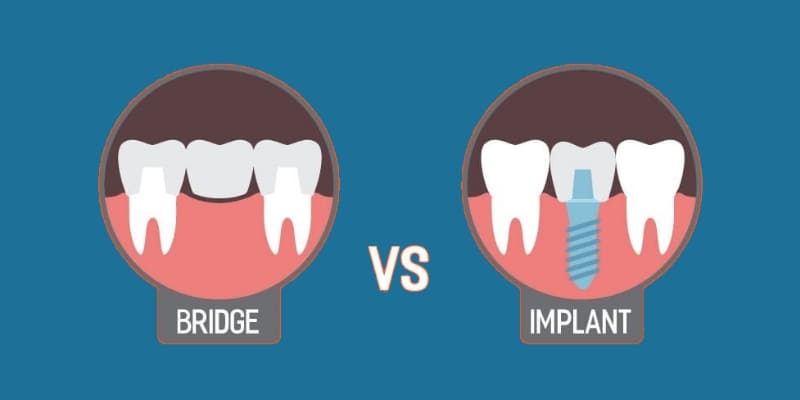
Process of tooth loss is stressful and challenging for anyone who experiences it. The impact on your confidence and everyday life can be profound. Finding alternatives to false teeth that are visible in social situations and photo-friendly is a priority for most people who have missing teeth. Luckily, restoration techniques like dental implants or a tooth bridge can help you regain your smile with minimum risk and cost. Both have their pros and cons, but the decision of whether to get one over the other is personal. Both procedures don’t require much surgical intervention; they are non-invasive treatments that are done under local anesthesia in about an hour. However, each has its own advantages and disadvantages that you should consider before making a final choice!
Who Is This Article For?
- Patients with one or more missing teeth
- Individuals comparing bridges and implants
- Patients seeking a faster tooth replacement option
- People with insufficient jawbone for implants
- Anyone exploring affordable tooth replacement solutions
What is a Dental Tooth Bridge?
A dental bridge is a false tooth that is designed to replace one or more missing teeth. It is a fixed prosthetic that is attached to natural teeth next to the missing teeth. It holds in place a false replacement tooth that is made up of materials like porcelain, gold, polymers. The bridge is typically made out of dental porcelain that is matched with the colour of nearby teeth. A bridge is a fixed restoration that is meant to be retained for life.
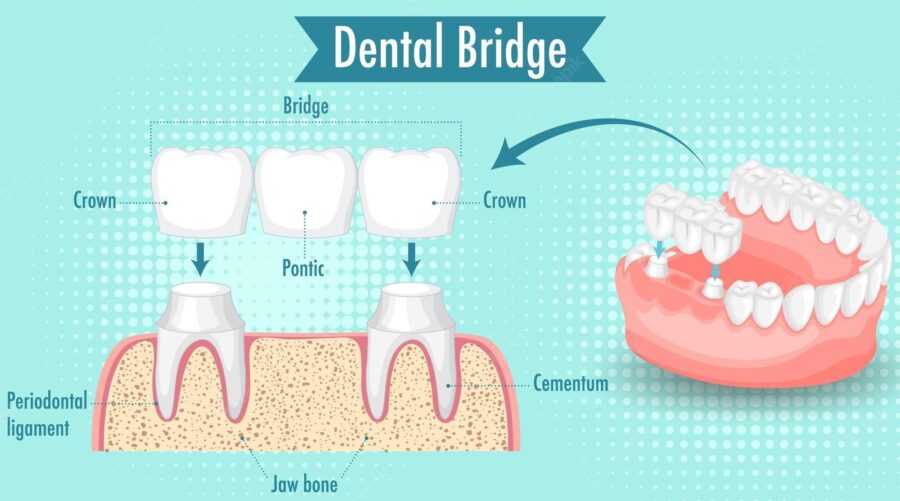
- It is a permanent appliance that replaces a missing tooth or missing teeth. It has several pieces that are fused together to fit into the open space where your tooth or teeth used to be.
- Dental bridges are an alternative to partial dentures as they can help you eat and speak more effectively and also make your teeth look better.
- A dental bridge can be made of different materials, including gold, alloys, or porcelain. When replacing a front tooth, porcelain is most often used because it can be matched to your natural tooth colour.
How do Dental Implants differ from a Tooth Bridge?
A dental implant is a surgical procedure that involves inserting a titanium screw into the jawbone. After the healing process, which usually takes a few months, you can get a crown made that is designed to replace one or more missing teeth. It is a removable prosthetic that is designed to be retained for life. Like a bridge, it holds in place a false tooth that is made up of materials like porcelain, gold, or resin. The replacement tooth is attached to the implant via metal clasps that are used to affix the false tooth to the implant. The implant is typically made out of titanium that is matched with the color of nearby teeth.
Benefits of having a framework over implants
- A Tooth bridge is basically a false tooth that is fixed over adjacent teeth. In contrast, a dental implant requires surgery to insert a titanium screw into the jawbone. Unlike a dental implant, bridges do not require a healing period and does not have any risk of infection.
- A bridge can be easily fixed if it breaks or gets misaligned. In contrast, a dental implant breaks and needs to be surgically removed and replaced.
- A bridge is more affordable than an implant. They are less invasive, and therefore, it is suitable for patients who are looking to avoid surgery or have medical conditions that prevent them from having surgery.
- Dental bridge is an option if you have an insufficient bone density in the jaw or if you are taking certain medications that inhibit bone growth.
Drawbacks of having a Bridge over Implants
- While a dental bridge does not require surgery, it does require that adjacent teeth stay healthy for the rest of your life. If adjacent teeth become loose and misaligned, you might need to get a dental bridge replaced with a dental implant.
- Depending on the materials used, a dental bridge might be more prone to staining and require regular cleaning. A dental bridge may interrupt adjacent teeth from properly aligning or erupting, which may affect natural teeth. A dental bridge might not last as long as a dental implant because it has to be fixed every few years.

Why you might want to choose an Implant over a Bridge
A dental implant is a more permanent alternative to a dental bridge that does not require periodic maintenance. – With time, an implant will fuse with the jawbone and become a natural part of the jaw. An implant is designed to be retained for life, and therefore, it does not require you to go back to the dentist every few years to get it fixed. An implant does not require adjacent teeth to be healthy. In fact, it is a great option if adjacent teeth are misaligned or loose. With time, an implant will fuse with the jawbone and become a natural part of the jaw. An implant is designed to be retained for life, and therefore, it does not require periodic cleaning.
Conclusion
While implants are a popular tooth replacement option, a tooth bridge may be the better choice for certain patients. Bridges can often be completed more quickly, may involve a lower initial cost, and can be suitable for individuals who are not ideal candidates for implant surgery. Bridges may also be recommended when adjacent teeth already require crowns or restorations. The right treatment depends on factors such as oral health, bone availability, treatment goals, budget, and personal preferences. A detailed dental evaluation can help determine whether a bridge or implant is the most appropriate solution for restoring your smile.
FAQ
Why would someone choose a dental bridge instead of an implant?
A dental bridge may be preferred because it usually requires less treatment time, may have a lower upfront cost, and can be suitable for patients who are not candidates for implant surgery.
Is a dental bridge cheaper than a dental implant?
In many cases, the initial cost of a dental bridge is lower than that of a dental implant. However, long-term costs may vary depending on maintenance and replacement needs.
Can I get a bridge if I do not have enough bone for an implant?
Yes. Patients with insufficient jawbone may be candidates for a dental bridge without requiring bone grafting procedures.
Does a dental bridge require surgery?
No. Traditional dental bridges do not require surgical placement into the jawbone, making them a less invasive option than dental implants.
How long does a dental bridge last?
With proper oral hygiene and regular dental care, dental bridges can often last between 5 and 15 years or longer.
When is a dental bridge recommended?
A bridge may be recommended when adjacent teeth already need crowns, when implant surgery is not suitable, or when a patient prefers a faster tooth replacement solution.
Can a dental bridge look natural?
Yes. Modern dental bridges are designed to match the color, shape, and appearance of natural teeth, helping restore both function and aesthetics.