Upper jaw cancer and its treatment can result in the loss of teeth, jawbone, and surrounding tissues, making everyday activities such as eating, speaking, and smiling more difficult. Fortunately, advances in oral and maxillofacial surgery now offer several reliable solutions for restoring fixed teeth after oral cancer treatment. Depending on the amount of remaining bone and the patient’s overall health, options such as conventional dental implants, zygomatic implants, pterygoid implants, and bone grafting can help restore oral function, facial aesthetics, and confidence. Every patient requires a personalized rehabilitation for Fixed Teeth After Upper Jaw Cancer. Advanced imaging with Cone Beam Computed Tomography (CBCT) allows surgeons to accurately assess bone quality and select the most appropriate treatment option for long-term success.
Who Is This Article For?
- Patients who have lost upper jaw teeth due to oral cancer treatment.
- Individuals considering fixed teeth after upper jaw cancer surgery.
- Family members seeking rehabilitation options.
- Patients exploring dental implants and advanced jaw reconstruction techniques.
Missing Teeth After Upper Jaw Cancer
Missing teeth affects the esthetics and overall facial appearance of an individual. Therefore, If missing teeth in time, it can cause various problems such as pathological migration of teeth, supra-eruption, speech impairment, chewing ability, malocclusion, decreases the integrity of jaw bone.
This in turn will cause difficulty in maintaining oral hygiene. Speech and phonetics hampered if teeth are not in proper alignment. As you lose more teeth, one will be forced to chew from other areas. Causing overload on certain teeth with excessive wear and tear and tempo mandibular joint dysfunction. In addition, improper chewing leads to poor nutrition thereby affecting overall growth and health of the patient.

Missing teeth affects appearance and smile. Patient's self-confidence goes down. Getting fixed teeth can improve quality of life.
Options for Fixed Teeth After Upper Jaw Cancer
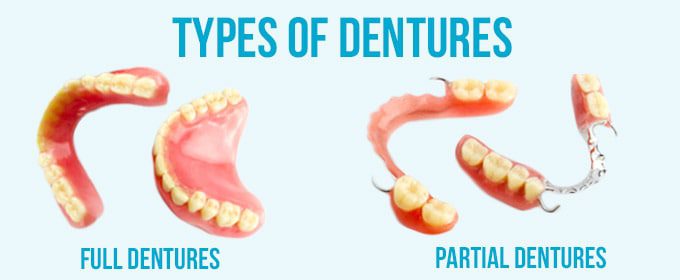
Removable Dentures
It is one of the oldest way of replacing missing teeth. Removable dentures are for partially edentulous. Patients who wants to have replacement of teeth for functional or aesthetic reasons. And who cannot have bridge for reasons such as lack of healthy adjacent teeth or for financial limitations. However, these removed and reinserted when required without dentist help. They are of two types: acrylic partial denture and cast partial denture. Complete dentures may be given when all teeth are missing within the jaw. They tissue supported. For thin or very less amount of bone complete dentures given over the implants for a proper fit.
Dental Implants after Upper Jaw Cancer
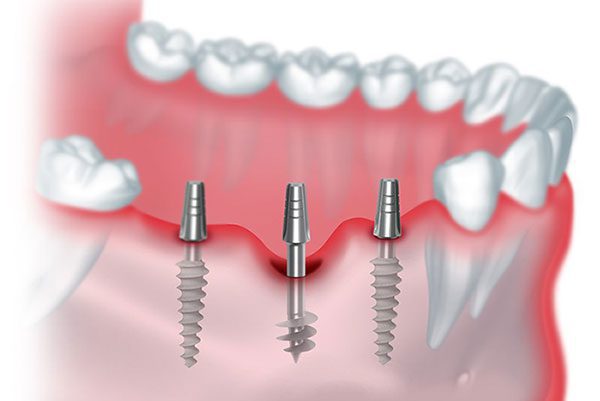
Dental implants are a great way to replace missing teeth. It fuse to jaw bone by osteointegration which is a process of formation of healthy bone around implants. This helps to keep the implant firm in its place so that it can bear the occlusal force and helps in mastication.
All-on-4 Dental Implants
The “all-on-four” treatment concept was developed to maximize the use of available remnant bone in atrophic jaws, allowing immediate function. Above all, avoiding regenerative procedures that increase the treatment costs and patient morbidity, as well as the complications inherent to these procedures. The protocol uses four implants in the anterior part of complete edentulous jaws to support a provisional, fixed and immediately loaded prosthesis. The two most anterior implants axially, whereas the two posterior implants distally and angled to minimize the cantilever length, and to allow the application of prostheses with up to 12 teeth, thereby enhancing mastication.
All-on-6 Dental Implants
ALL-on-6 dental implant procedure is the creation of a complete dental prosthesis, anchored to the jawbone (top) or mandible (bottom) by six titanium implants, integrated into the bone and evenly distributed along the jaw. An arch, topped with false gums and ceramic or porcelain dentures, completes the device by screwing onto the six implants embedded in the jaw. This treatment advantage of being able to be implanted on a low volume of jawbone and is intended for patients whose mouths are completely or partially edentulous in one or two jaws, or who have several missing teeth. It corrects a bite defect, restoring more harmonious proportions to the lower face.
ALL-on-6 procedure performed in two sessions about four months apart while the implants integrate perfectly into the bone and gums. During this time, a temporary prosthesis is attached to the implants. Above all ALL-on-6 solution avoids the more invasive bone grafting. In addition offers a faster recovery time and lower cost than other implant treatment techniques. In addition, sinus lift surgery not required. If the jawbone is too thin, too weak or degraded, a bone graft will be prescribed. Usually created with synthetic biocompatible material, it reinforces the bone on which the implant will be implemented.
Zygomatic Implants after Upper Jaw Cancer
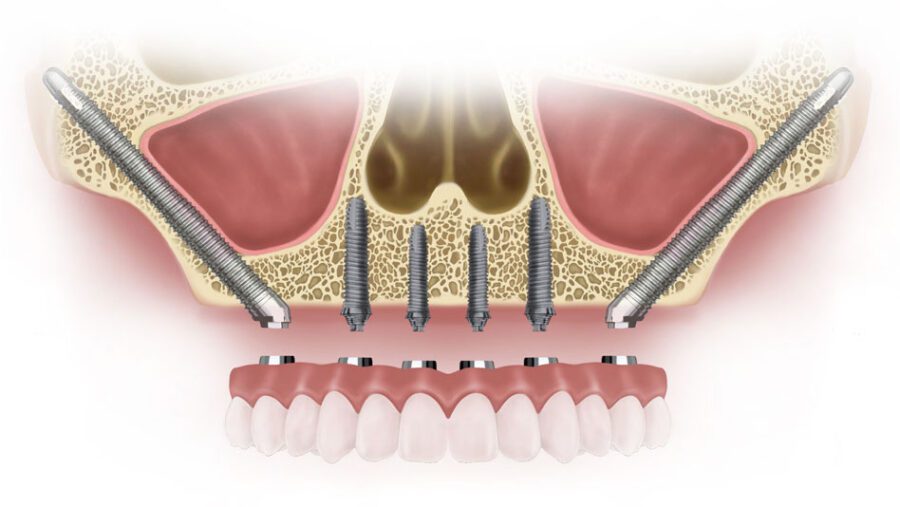
They are long, angled endosseous implants placed into the zygoma as an augmentation procedure in severely atrophic maxilla. Zygomatic Implants anchored into the zygomatic bone. They do not require bone graft and sinus lift procedures. This is less invasive procedure. They recommended in patients who had failed dental implants, failed bone grafting operations and extreme jaw bone loss.
Pterygoid Implants
The Pterygoid implants are “pterygo-maxillary implants” and “tuberosity implants.” Pterygoid implants allow patients with severe upper jawbone loss. Placement of pterygoid implants involves origination of implants in the tuberosity region and follows an oblique mesiocranial direction proceeding posteriorly toward the pyramidal process. It subsequently proceeds upward between both the wings of pterygoid process of sphenoid bone. The primary reason for placing the implants in the pterygoid region is that the cortical bone present in this region is very dense. This helps in proper retention of implant. In addition it also helps to overcome the need for maxillary sinus elevation and bone grafting procedures.
Surgical placement of pterygoid implants is straightforward for an experienced clinician and can be performed under local anaesthesia in a dental office. Furthermore, this is in contrast to zygomatic implants. In addition, which usually entail a larger surgical procedure and require sedation or general anaesthesia. This shortens the treatment time and allows immediate loading of the pterygoid implant. Furthermore, it allows the fabrication of a partial arch or complete arch prosthesis.
Bone Grafts for Fixed Teeth After Upper Jaw Cancer
- Firstly, increased bone density for patients who have insufficient upper jawbone material due to gum disease. In addition the natural process of aging, genetics, or tooth loss
- Improved likelihood of successful placement of dental implants
- Secondly, indirect sinus lift offers a less invasive procedure to create sufficient bone for implant placement-without direct bone grafting. In addition which can require a second procedure to harvest bone from another part of the body
- Above all, indirect sinus lift, when combined with osseodensification. In addition can increase the quality of the surrounding bone in the upper jaw when done at the same time
- Minimal discomfort
Modern implant rehabilitation has significantly improved outcomes for patients treated for upper jaw cancer. With appropriate planning and multidisciplinary care, many patients can receive fixed teeth that restore chewing efficiency, improve speech, support facial structures, and enhance overall quality of life. Regular follow-up appointments and excellent oral hygiene remain essential for maintaining these long-term results.
Conclusion
Losing teeth following upper jaw cancer treatment can affect eating, speaking, appearance, and self-confidence, but modern rehabilitation techniques provide highly effective solutions. Depending on your individual condition, options such as dental implants, All-on-4, All-on-6, zygomatic implants, pterygoid implants, and bone grafting can help restore function and improve quality of life. A comprehensive evaluation by an experienced oral and maxillofacial surgeon is essential to determine the most appropriate treatment plan for long-term success.
FAQs
Can I get dental implants after upper jaw cancer?
Yes. Many patients are suitable candidates for dental implants after oral cancer treatment, depending on bone quality, healing, and overall health.
What are zygomatic implants?
Zygomatic implants are longer dental implants anchored in the cheekbone (zygoma), making them an excellent option for patients with severe upper jaw bone loss.
Are pterygoid implants an alternative to bone grafting?
In selected cases, pterygoid implants can avoid the need for bone grafting or sinus lift procedures by using dense bone in the pterygoid region.
How long does rehabilitation take after upper jaw cancer?
Recovery varies depending on the extent of surgery and treatment, but complete rehabilitation with implants may take several months.
Is bone grafting always necessary?
No. Some patients can receive zygomatic or pterygoid implants, which may eliminate the need for bone grafting, depending on their clinical condition.