
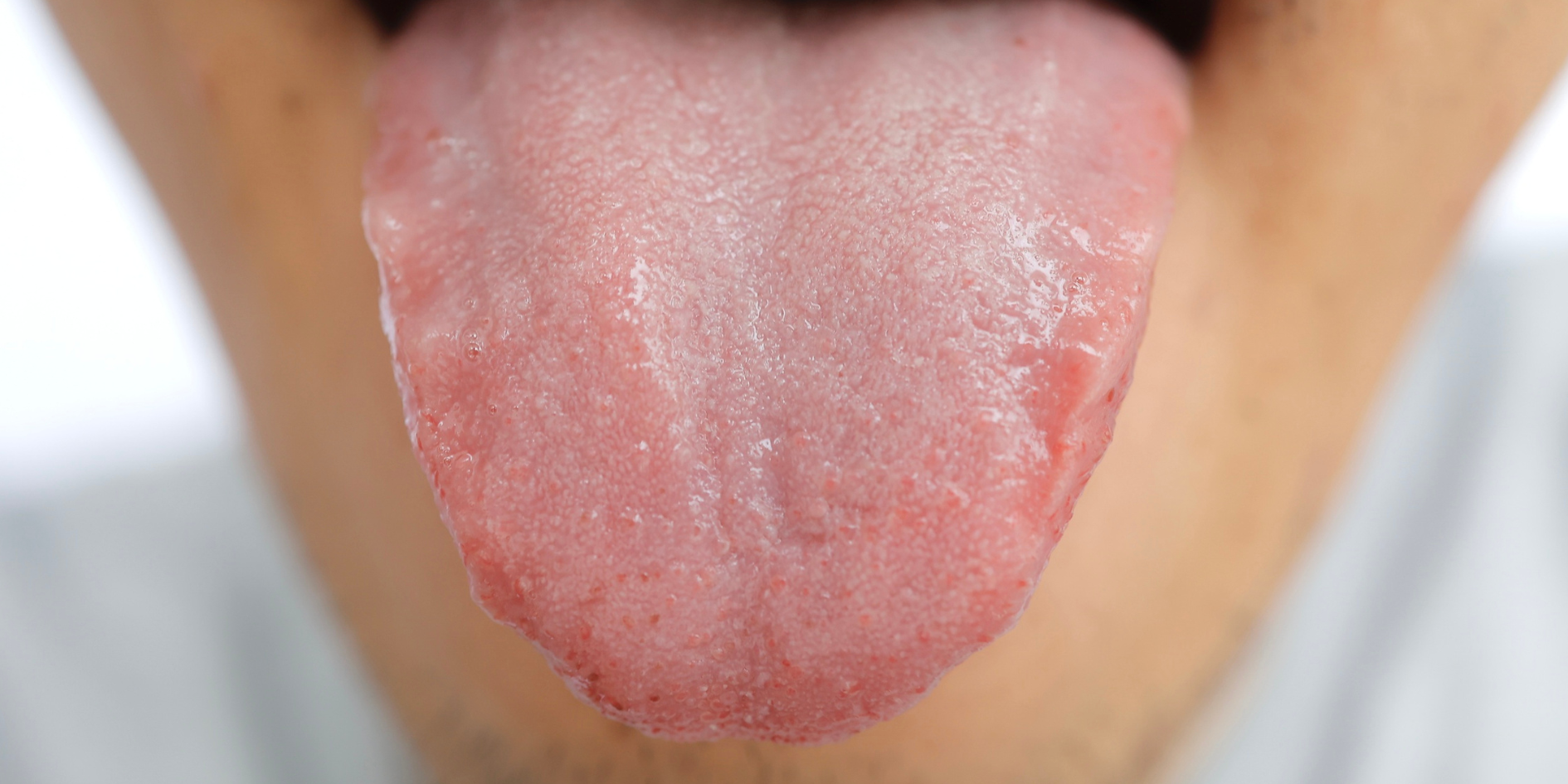
A white tongue is a common condition in which the surface of the tongue develops a white coating or patches. It may occur due to poor oral hygiene, dehydration, fungal infections, smoking, certain medications, or underlying medical conditions. While many cases are harmless and improve with proper oral care, persistent white patches or associated pain should be evaluated by a dentist or healthcare professional to rule out more serious conditions.

Who Is This Article For?
- People who notice a white coating on their tongue.
- Patients with persistent bad breath.
- Denture wearers.
- Individuals with diabetes or weakened immunity.
- Tobacco users concerned about oral health.
- Anyone experiencing persistent white patches inside the mouth.
What Causes a White Tongue?
A white tongue develops when dead cells, bacteria, fungi, food debris, or inflammatory changes accumulate between the tiny papillae on the tongue’s surface. The appearance may range from a thin white coating to thick patches, depending on the underlying cause. A clinical examination helps determine whether the condition is temporary or requires further investigation.
White lesions on tongue can present itself in various clinical forms
Leukoplakia: In this condition there is a white patch on tongue that cannot scrap off. It is a precancerous lesion. Advanced forms may develop red patches.
Candidiasis White Layer Over Tongue: Candidiasis is the disease caused by infection with yeast like fungus Candida Albicans. It is also called as oral thrush. It presents as white patches resembling cottage cheese appearance; most commonly seen in infants, denture wearers and people with weak immunity , patients with diabetes and who are taking corticosteroids for lung diseases and Asthama. Two forms of Candidiasis namely Pseudomembranous candidiasis and Chronic hyperplastic candidiasis present as white patches on tongue.

Lichen Planus: It consists of bilateral white striations , papules or plaques on the buccal mucosa , tongue and gingiva. Erythema, erosions and blisters may or may not be present. Firstly there is involvement of the oral mucous membrane. These lesions appear as small, angular, flat topped papules only a few millimeters in diameter. However, they may isolate or can form into larger plaques each of which cover by a fine glistening scale. The surface cover by characteristics greyish white lines called wickham striae. Classically it characterized by lesions consisting of radiating white or grey, velvety , thread like papules in a linear, annular or retiform arrangement forming typical lacy, reticular patches, rings and streaks over the buccal mucosa and to a lesser extent on the lips, tongue and palate.
Syphilis White Layer Over Tongue: It regarded as a predisposing factor for the development of leucoplakia. In addition, white patches often seen on tongue in secondary syphilis. In addition, Spirochetes is the causative agent for syphilis and has high affinity for the actively mobile tissues of tongue. There is atrophy of filiform and fungiform papillae resulting in bald and smooth surface of tongue. However, with the protective papillae missing the dorsum of the tongue is left extremely susceptible to oral irritation and leukoplakia frequently develops on it.
White Sponge Nevus: In other words, it is also called as white folded gingivostomatitis. It is an autosomal dominant lesion. Hence, Mucosa appears thickened and folded or corrugated with soft or spongy texture and a peculiar white opalescent line .It has rough , granular appearance. However, the lesion varies in extent from a small patch to a larger area.
Pachyonychia Congenita: It is also called as Jadassohn-Lewandowsky syndrome. It inherited as an autosomal dominant characteristic. However, it is extremely uncommon disease. In addition, it consists of focal or generalised white opaque thickening of the mucosa. Frequent apthous ulceration seen. Above all, inflammation of the angle of mouth visible in some cases.
In this intriguing video, Dr. Chirag Chamria, Royal Dental Clinics, emphasises on how the health of your tongue is an indicator of your Oral Health and overall health. As per Dr. Chirag Chamria, Oral & Maxillofacial Surgeon at Royal Dental Clinics, “For us, excellence is our constant pursuit. Patients want immediate results & are no longer ready to hold back for days to restore their smile. We strive for nothing less than the mastery of this medium in which we have chosen to craft.”
Focal Epithelial Hyperplasia: In other words, it described as Heck Disease. It characterised by multiple papillomatous like lesion. The viral induced oral mucosal hyperplastic response. Caused by virus (PAPOVA virus group). These present as multiple nodular lesions with sessile base. Sometimes it is present as flat , slightly raised whitish plaque on a roughened surface. It may occur in clusters or isolated. It is non tender. If the mucosa stretched they become less conspicuous. After that, the lesion reveals finely granular surface texture. In addition, they are pale to normal in colour.
𝐀 𝐡𝐞𝐚𝐥𝐭𝐡𝐲 𝐭𝐨𝐧𝐠𝐮𝐞 𝐢𝐬 𝐩𝐢𝐧𝐤 𝐢𝐧 𝐜𝐨𝐥𝐨𝐫 𝐚𝐧𝐝 𝐡𝐚𝐬 𝐧𝐨𝐝𝐮𝐥𝐞𝐬 𝐨𝐧 𝐢𝐭 𝐜𝐚𝐥𝐥𝐞𝐝 𝐩𝐚𝐩𝐢𝐥𝐥𝐚𝐞. 𝐀𝐧𝐲 𝐝𝐞𝐯𝐢𝐚𝐭𝐢𝐨𝐧 𝐟𝐫𝐨𝐦 𝐧𝐨𝐫𝐦𝐚𝐥 𝐚𝐩𝐩𝐞𝐚𝐫𝐚𝐧𝐜𝐞 𝐨𝐟 𝐢𝐭 𝐨𝐫 𝐩𝐚𝐢𝐧 𝐜𝐨𝐮𝐥𝐝 𝐛𝐞 𝐚 𝐦𝐚𝐭𝐭𝐞𝐫 𝐨𝐟 𝐜𝐨𝐧𝐜𝐞𝐫𝐧.
Dyskeratosis Congenita: It described as Zinssner-Engman-Cole syndrome. Disease manifested as three typical signs: oral leucoplakia, dystrophy of nails and pigmentation of skin. Most commonly seen in males .It appears as diffuse distributed vesicles and ulcerations on tongue followed by accumulation of white patches of necrotic epithelium and sometimes superimposed monolial infection. Therefore, in the age group of 14-20 years there repeat recurrent ulceration and development of erythroplasia . In the age of 20-30 years there is development of erosive leucoplakia and carcinoma.
Oral Squamous Cell Carcinoma: In conclusion, it is most common type of oral cancer. It is a malignant epithelial neoplasm exhibiting squamous differentiation characterized by formation of keratin and or the presence of intercellular bridges.it presents as ulcerated lesion with indurated margins.
𝐀 𝐡𝐞𝐚𝐥𝐭𝐡𝐲 𝐭𝐨𝐧𝐠𝐮𝐞 𝐢𝐬 𝐩𝐢𝐧𝐤 𝐢𝐧 𝐜𝐨𝐥𝐨𝐫 𝐚𝐧𝐝 𝐡𝐚𝐬 𝐧𝐨𝐝𝐮𝐥𝐞𝐬 𝐨𝐧 𝐢𝐭 𝐜𝐚𝐥𝐥𝐞𝐝 𝐩𝐚𝐩𝐢𝐥𝐥𝐚𝐞. 𝐀𝐧𝐲 𝐝𝐞𝐯𝐢𝐚𝐭𝐢𝐨𝐧 𝐟𝐫𝐨𝐦 𝐧𝐨𝐫𝐦𝐚𝐥 𝐚𝐩𝐩𝐞𝐚𝐫𝐚𝐧𝐜𝐞 𝐨𝐟 𝐢𝐭 𝐨𝐫 𝐩𝐚𝐢𝐧 𝐜𝐨𝐮𝐥𝐝 𝐛𝐞 𝐚 𝐦𝐚𝐭𝐭𝐞𝐫 𝐨𝐟 𝐜𝐨𝐧𝐜𝐞𝐫𝐧.
Tongue is one of the vital sensory organs which plays an important role from eating to speaking. It provides a nidus for food debris, bacteria, and contaminants. When tongue is not cleaned properly it can cause bad breadth, tooth decay, lesions etc. There seems to be a direct relation between your tongue and oral health.
How Is White Tongue Treatment done?
Treatment depends entirely on the underlying cause. Improving oral hygiene, cleaning the tongue daily, staying well hydrated, and treating contributing conditions often resolve a simple white coating. If the cause is oral thrush, antifungal medication may be prescribed. Persistent white patches that cannot be wiped away, or patches associated with pain, ulcers, or tobacco use, require professional evaluation and may need further investigation, including biopsy in selected cases.

Who is most at risk for white tongue? Is it genetic?
- Having diabetes.
- Being very young or very old.
- Using antibiotics.
- Eating a diet with a shortage of fruits and vegetables (iron or vitamin B12).
- Having a fever or a weak immune system.
- Wearing dentures or damaging your tongue with sharp objects.
- Having poor oral hygiene.
- Being dehydrated.
- Smoking or chewing tobacco or consuming alcohol.
- Undergoing cancer treatments.
Why Choose Royal Dental Clinics?
Royal Dental Clinics provides comprehensive diagnosis and management of oral lesions using detailed clinical examinations, advanced imaging when required, and personalised treatment plans. Our experienced dental specialists focus on identifying the underlying cause and providing evidence-based care to protect your oral health.
Conclusion
A white tongue is often caused by harmless conditions such as poor oral hygiene or dehydration, but persistent white patches should never be ignored. Early diagnosis allows many conditions to be treated successfully while helping identify more serious oral diseases at an early stage. Maintaining excellent oral hygiene and attending regular dental check-ups are the best ways to keep your tongue and mouth healthy.
Concerned About a White Tongue?
If you’ve noticed a persistent white coating or patch on your tongue, schedule a consultation at Royal Dental Clinics. Early diagnosis helps identify the underlying cause and ensures you receive the most appropriate treatment.
FAQs
Is a white tongue serious?
Most cases are harmless and improve with better oral hygiene. However, persistent white patches require professional evaluation.
Can dehydration cause a white tongue?
Yes. Reduced saliva flow allows bacteria and debris to accumulate on the tongue’s surface.
Is white tongue caused by oral thrush?
Oral thrush is one possible cause, but white tongue may also result from poor oral hygiene, smoking, leukoplakia, or other conditions.
Can I scrape a white tongue clean?
A removable white coating may improve with gentle tongue cleaning, but patches that cannot be scraped away should be examined by a dentist.
When should I seek treatment?
If the white coating lasts longer than two weeks, becomes painful, or cannot be removed, you should schedule a dental or medical evaluation.