


If you have been advised to get zygomatic implants then read the patient information on zygomatic dental implants below:
Have you been told you do not have enough bone for dental implants? For many patients, this news feels like the end of the road. You may have spent years struggling with loose dentures or missing teeth, only to be informed that traditional implants are not possible without extensive, lengthy bone grafting surgeries. However, modern maxillofacial surgery offers alternatives. Zygomatic dental implants may provide a solution for selected cases, allowing patients to achieve fixed teeth by bypassing the jawbone entirely.
This guide is designed to provide you with simple, clinical, and ethical information so you understand exactly what zygomatic implants are, how they work, and what the real journey entails.
Who Is This Article For?
This comprehensive patient guide is written specifically for individuals who:
- Wish to understand their options before committing to major bone grafting or sinus lift surgeries.
- Have severe bone loss in the upper jaw.
- Struggle daily with loose, slipping upper dentures.
- Have suffered from previously failed dental implants or failed bone grafts in the upper jaw.
- Have been explicitly told that “regular implants are not possible.“
Table of Contents
Why Regular Implants May Not Work in Severe Upper Jaw Bone Loss
When you lose your natural teeth, the jawbone that once supported them no longer receives stimulation from chewing. Over time, the body naturally absorbs this unused bone—a process called bone resorption.
In the upper jaw, this is further complicated by the maxillary sinus. As teeth are lost, the sinus cavity expands downward (pneumatization). Eventually, the bone becomes paper-thin. Regular dental implants are essentially small titanium screws that need a certain height and width of dense jawbone to anchor securely. If a surgeon tries to place a regular implant into a severely shrunken jaw, it will lack the foundation needed to support the heavy forces of chewing.
To help you understand the core differences, here is a simple comparison:
| Feature | Regular Dental Implants | Zygomatic Dental Implants |
|---|---|---|
| Anchor Point | The upper jawbone (maxilla) | The dense cheekbone (zygoma) |
| Implant Length | Short (typically 10 to 15 mm) | Extra-long (typically 30 to 60 mm) |
| Bone Required | Needs adequate jawbone height and width | Designed specifically for severe jawbone loss |
| Need for Bone Grafting | Often required if jawbone is thin | May completely avoid the need for bone grafting |
| Procedure Type | Standard implant placement | Advanced maxillofacial surgical procedure |
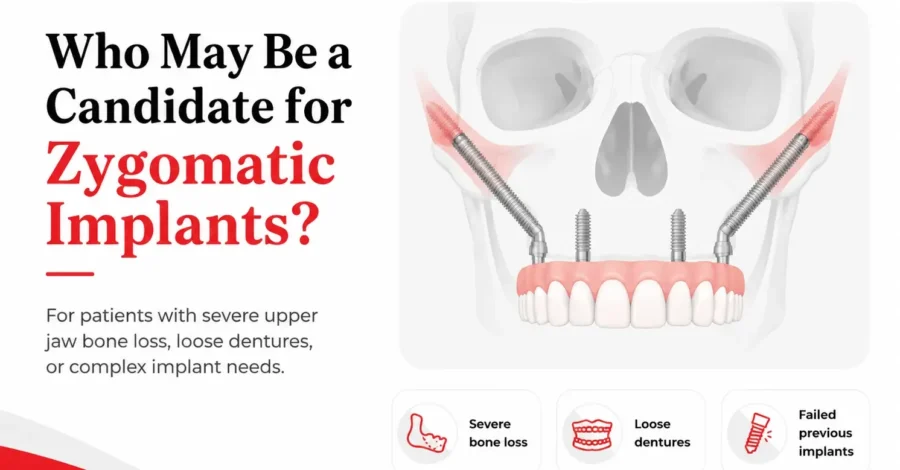
Who May Be a Candidate – Patient Information
Who Needs Careful Evaluation?
While zygomatic implants are transformative, they are not for everyone. Suitability is highly case-dependent. Certain conditions require very careful medical evaluation and may require treatment before surgery can be considered:
- Active Sinus Infections: Unresolved sinus issues must be cleared by an ENT specialist first.
- Uncontrolled Diabetes: We typically look for an HbA1c level below 8% to ensure proper soft-tissue healing.
- Heavy Smoking: Smoking severely restricts blood flow and can compromise implant healing.
- Poor Oral Hygiene: A commitment to daily cleaning is required to prevent infections.
- Previous Radiation Therapy or Oral Cancer: Requires modified techniques such as ZIP flaps.
- Blood Thinners and Cardiac History: Must be managed collaboratively with your physician to prevent surgical risks.
Diagnosis and Planning
The right decision starts with clinical examination and CBCT-based planning.
A high-resolution 3D CBCT scan is recommended to map the exact volume of your cheekbone and evaluate the health of your sinuses. During your consultation, we also perform a thorough clinical exam evaluating your bite, your smile line, lip support, and your complete medical history.
Treatment Options for Severe Bone Loss
Of course Zygomatic Implants are not the only option, there are other options with its own pros and cons. We believe in transparency. Depending on your CBCT scan, your options for an atrophic upper jaw may include:
- Traditional Dentures: Non-surgical but removable, often loose.
- Bone Grafting (from hip/rib): Rebuilds the jawbone but requires multiple invasive surgeries and 6–12 months of healing.
- Sinus Lifts: Elevating the sinus membrane to pack bone material; suitable for localized bone loss.
- Pterygoid Implants: Implants anchored in the bone behind the upper jaw, often used alongside other implants.
- Bi-Zygomatic Implants: Two zygomatic implants in the back, paired with regular implants in the front jaw.
- Quad Zygomatic Implants: Four zygomatic implants used when there is absolutely zero bone left in the entire upper jaw.
Benefits of Zygomatic Implants
Read our article on the details of zygomatic implant here. For suitable candidates, the primary benefit is the ability to achieve fixed teeth without undergoing complex bone grafting. This significantly reduces the number of surgeries, drastically lowers treatment timelines, and offers massive, early quality-of-life gains for patients who previously had no options.
Can Fixed Teeth Be Given on the Same Day?
In suitable cases, fixed temporary teeth may be attached on the same day. These are not the final teeth; they protect the implants and help the patient function during healing.
Because the cheekbone is so dense, it often provides enough primary stability to support a lightweight provisional (temporary) bridge immediately after surgery. This means you do not leave the clinic toothless. However, you must adhere to a strict soft-food diet to allow the implants to integrate safely with your bone.
Step-by-Step Treatment Journey
In zygomatic implant treatment, the surgery and the teeth cannot be planned separately.
- Digital Planning: We map the surgery virtually using your CBCT scan.
- Surgical Guide Fabrication: In majority of cases 3D-printed templates are made for precise accuracy.
- Surgery: The implants are carefully placed, often using minimally invasive techniques.
- Immediate Provisionalization: A lightweight, temporary framework (such as SAPTeeth™) is securely attached to the implants.
- Healing Phase: A 3 to 6-month period where the implants permanently fuse to your bone.
- Final Prosthesis: Once healed, your final, highly aesthetic permanent teeth are custom-designed and attached.
Pain, Anesthesia, Swelling, and Recovery
Modern zygomatic surgery has evolved significantly. While it was once performed under general anesthesia in a hospital, many cases are now performed comfortably in the clinic under local anesthesia with or without sedation.
You may experience mild to moderate swelling and bruising for a few days, which is managed with prescribed medications and cold compresses. Because advanced clinics utilize 3D-guided, “pinhole” or minimal-flap approaches, tissue trauma is greatly reduced, making recovery much smoother than traditional bone grafting.
Risks and Complications
Every surgical procedure carries risks, and zygomatic implants are no exception. While long-term success rates are globally documented at around 96%, potential complications may include:
- Sinusitis or sinus inflammation (often prevented with proper planning and ENT care).
- Soft-tissue recession (dehiscence) around the implant.
- Post-operative swelling or minor bleeding.
- Prosthetic wear or loosening of tiny screws over time.
Food, Cleaning, and Maintenance
A zygomatic implant requires lifelong care
Diet: You must maintain a strict non sticky food diet.
Cleaning: You will need to use a water flosser and salt water gargles along with routine aids daily to clean beneath the fixed bridge.
Maintenance: Professional cleaning and prosthetic check-ups are required every 6 months to ensure the gums stay healthy and the bite remains balanced.
Cost Factors
The cost depends on the number of zygomatic implants required (two versus four), the need for additional regular implants, the type of prosthetic material chosen, and necessary diagnostic scans. While zygomatic implants represent a significant investment, they are typically more cost-effective than the cumulative expenses of hospital stays, hip-bone harvesting, and years of staged grafting procedures. The costs of Zygomatic Implant can range from Rs 1,50,000 to 2,50,000 per implant.
What should I expect from the procedure?
The zygomatic dental implant procedure is quick and fairly painless. The dentist will numb the area before making a small cut for access. The implant placed in the upper jaw to replace one or more missing teeth. Zygomatic dental implants are made of titanium and the process lasts about an hour.
Using implants can be especially helpful for people who have lost their tooth due to decay, injury, or corrective dental work. Implants provide a more natural-looking result as they on top of existing teeth rather than within them. For individuals with missing teeth, this procedure can help minimize loss of chewing ability and stability in the face which can lead to serious issues such as breathing problems and gum disease.
Why Surgeon Experience and Prosthetic Planning Matter
Zygomatic implants are not planned only for where the implant can be placed. They are planned for where the final teeth should come.
This procedure requires an intricate understanding of maxillofacial anatomy, biomechanics, and digital dentistry. A highly experienced surgeon will perform the surgery “in their mind first” using virtual software, ensuring the implant navigates safely around the sinus and eye socket, while the prosthetic team ensures your new teeth emerge at the exact right angle for speaking and chewing.

Questions Patients Should Ask Before Treatment
Before proceeding, be your own advocate. Ask your surgeon:
Surgeon Experience & Technology
- How many zygomatic implants have you placed? Experience matters.
- Do you use 3D CBCT planning and surgical guides? Modern safety relies on mapping the surgery virtually first.
- Can this be done under local anaesthesia (with or without light sedation)? Modern flapless or pinhole techniques often allow for local anaesthesia. If the surgeon is recommending general anaesthesia (GA) and a hospital stay, ask them to explain why.
- What complications have you encountered? Specifically ask how they manage common risks like sinusitis, soft-tissue dehiscence (gum recession), or prosthetic fracture.
- When do I receive my final prosthesis? Understand the difference between the temporary teeth you may get on day one and the final permanent teeth.
- For out-of-town/NRI patients: Exactly how many days do I need to stay in the city for the procedure and initial follow-ups?.
Patient Expectations
Zygomatic implants can be life-changing, but they are a medical journey, not a magic wand. Healing takes time. You must be willing to modify your diet during the initial months and commit to rigorous oral hygiene. If you set realistic expectations and follow your surgeon’s guidance, the result is a stable, confident smile.
Routinely there is some swelling especially on the cheek region for a few days which heals. After the first 48-72 hours the patients start eating their regular but softer diet. The most important factor is the post treatment cleaning and regular checkup.
Why Consult Royal Dental Clinics, Mumbai
Royal Dental Clinics has been at the forefront of rehabilitation since over 4 decades. With an integrated in-house CAD-CAM laboratory, high-resolution 3D CBCT imaging, and the expertise of Oral and Maxillofacial Surgeon Dr. Chirag Chamria, we execute the “One Day Zygoma Protocol” using modern, suture-less techniques under local anesthesia. Our team synchronizes the surgical and prosthetic phases to ensure your safety and comfort.
Frequently Asked Questions (FAQs)
What is the most important patient information on Zygomatic Dental Implants regarding who is a suitable candidate?
ygomatic dental implants are specifically designed for patients who have severe bone loss in the upper jaw and have been told they lack the bone for regular implants. Suitable candidates often include those struggling with loose and slipping dentures, patients who have suffered from previously failed implants or bone grafts, and oral cancer survivors.
What essential patient information on Zygomatic Dental Implants should I know about the surgery and potential pain?
Modern zygomatic implant surgery is remarkably patient-friendly. Utilizing 3D-printed surgical guides, the procedure is often performed using a minimally invasive, suture-less “pinhole” or micro-tunnel technique. Because there are no large incisions or invasive bone grafting required, post-operative pain, bruising, and swelling are drastically reduced, and the surgery is routinely performed under local anaesthesia with conscious sedation
Does the patient information on Zygomatic Dental Implants state that I can get fixed teeth on the exact same day?
Yes, in selected and suitable cases, patients can receive fixed teeth on the same day as the procedure. Because the dense cheekbone provides massive “primary stability” for the extra-long implants, surgeons can immediately load them with a lightweight provisional prosthesis (such as SAPTeeth™ frameworks), allowing you to walk out with a restored smile in just a few hours
What critical patient information on Zygomatic Dental Implants is provided regarding proper diagnosis and planning?
A responsible diagnosis cannot be made with a standard 2D X-ray; a high-resolution 3D CBCT scan is absolutely mandatory. This scan allows the maxillofacial surgeon to map the exact volume of your cheekbone, evaluate the health of your sinuses, and digitally plan the exact trajectory of the implants before the surgery even begins
What patient information on Zygomatic Dental Implants should I be aware of concerning risks and complications?
While global consensus shows a long-term survival rate of over 96%, it is an advanced surgery with potential risks. Complications can include sinusitis, minor soft-tissue recession (gum pulling back), or the loosening of prosthetic screws over time. However, modern techniques like the extra-maxillary (ZAGA) pathway—which places the implant completely outside the sinus wall—have reduced complication rates to under 3%
Dr Chirag Chamria Review + Disclaimer
Medically Reviewed By: Dr. Chirag Chamria, Oral and Maxillofacial Surgeon Last Reviewed On: 07th July 2026
Disclaimer: The information provided in this article is for educational and informational purposes only and does not constitute medical or dental advice. Every patient’s anatomy, bone density, and medical history are unique. Clinical decisions should always be made in accordance with each patient’s individual needs and under proper professional supervision. Candidacy for zygomatic implants can only be determined after a comprehensive clinical examination and a 3D CBCT scan. Please consult with a qualified maxillofacial surgeon before making any decisions regarding full-mouth rehabilitation or advanced implant procedures. Treatment suitability, cost, timeline, healing, and results vary from patient to patient.
Medical Disclaimer
This article is for patient education only. Dental treatment should be planned after clinical examination, medical history review, and X-rays or scans where required. Treatment suitability, cost, timeline, healing, and results vary from patient to patient.